

7th September 2026
Sorted out the design for the Concept map images, so update based on that.
Also iterated the text to tighten it up a little.
Identify the Scope
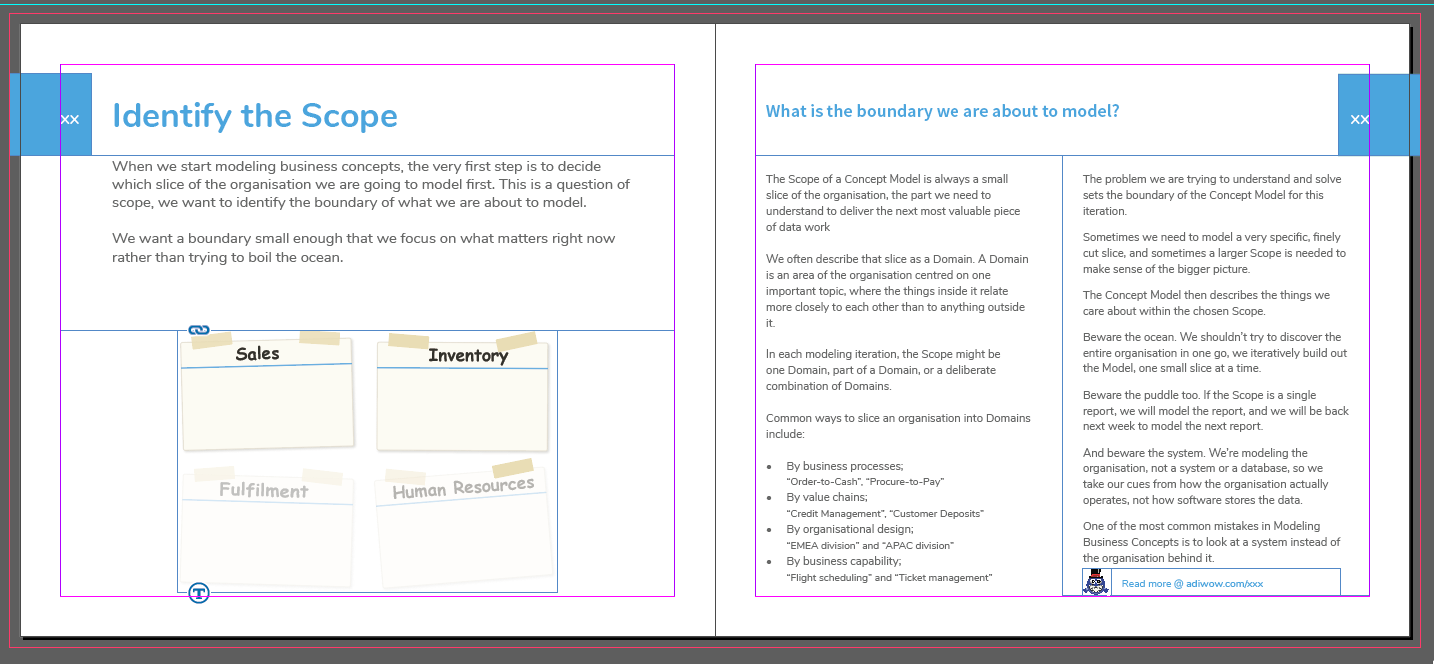
When we start modeling business concepts, the very first step is to decide which slice of the organisation we are going to model first. This is a question of scope, we want to identify the boundary of what we are about to model.
We want a boundary small enough that we focus on what matters right now rather than trying to boil the ocean.
What is the boundary we are about to model?
The Scope of a Concept Model is always a small slice of the organisation, the part we need to understand to deliver the next most valuable piece of data work
We often describe that slice as a Domain. A Domain is an area of the organisation centred on one important topic, where the things inside it relate more closely to each other than to anything outside it.
In each modeling iteration, the Scope might be one Domain, part of a Domain, or a deliberate combination of Domains.
Common ways to slice an organisation into Domains include:
By business processes;
“Order-to-Cash”, “Procure-to-Pay”
By value chains;
“Credit Management”, “Customer Deposits”
By organisational design;
“EMEA division” and “APAC division”
By business capability;
“Flight scheduling” and “Ticket management”
The problem we are trying to understand and solve sets the boundary of the Concept Model for this iteration.
Sometimes we need to model a very specific, finely cut slice, and sometimes a larger Scope is needed to make sense of the bigger picture.
The Concept Model then describes the things we care about within the chosen Scope.
Beware the ocean. We shouldn’t try to discover the entire organisation in one go, we iteratively build out the Model, one small slice at a time.
Beware the puddle too. If the Scope is a single report, we will model the report, and we will be back next week to model the next report.
And beware the system. We’re modeling the organisation, not a system or a database, so we take our cues from how the organisation actually operates, not how software stores the data.
One of the most common mistakes in Modeling Business Concepts is to look at a system instead of the organisation behind it.
26th February 2026
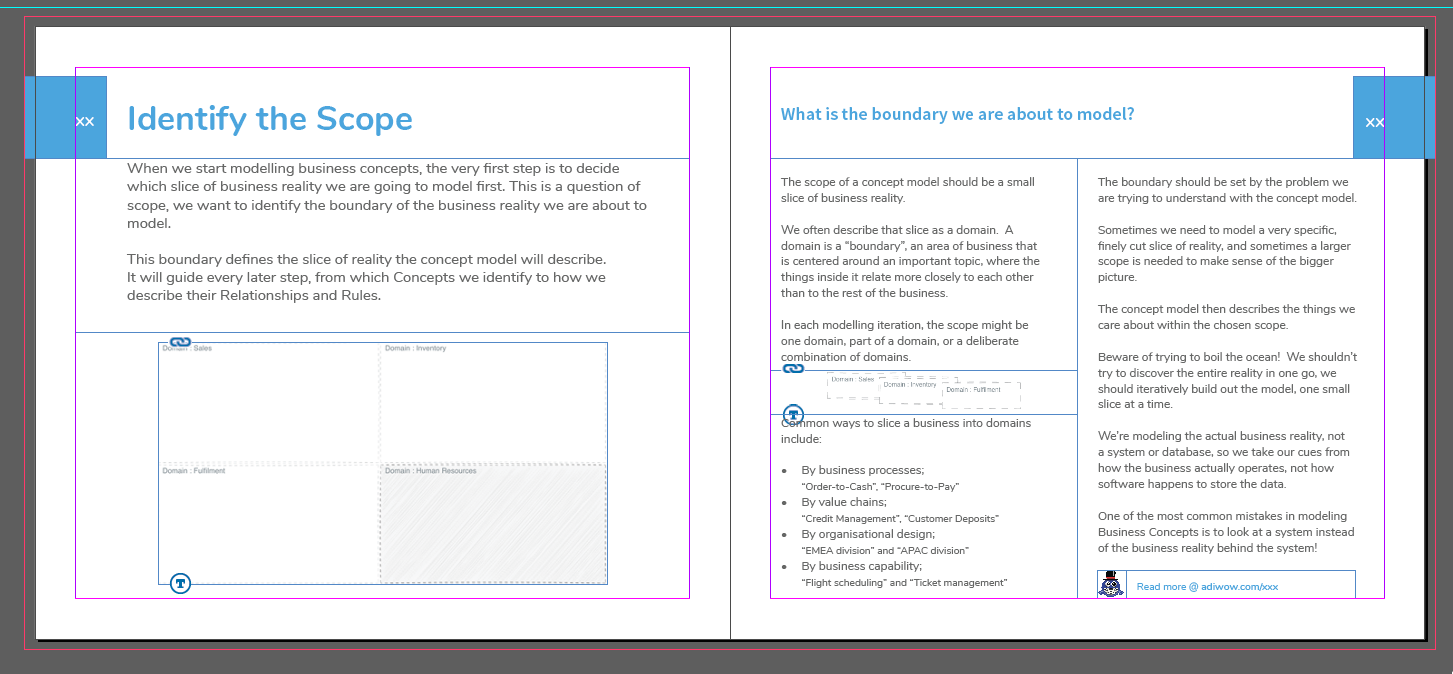
Change the ratio of the left page image so it fits the wide format of the book better,
Added an image to the right page to give it an example, will carry this through into the other page steps.
Iterated the text to tighten the language and recorded it to flow the “story” better.
Will still require a final iteration when the other steps are done, to make sure this chapter flows coherently across all the pages.
17th February 2026
Slight update to the intro text for this page.
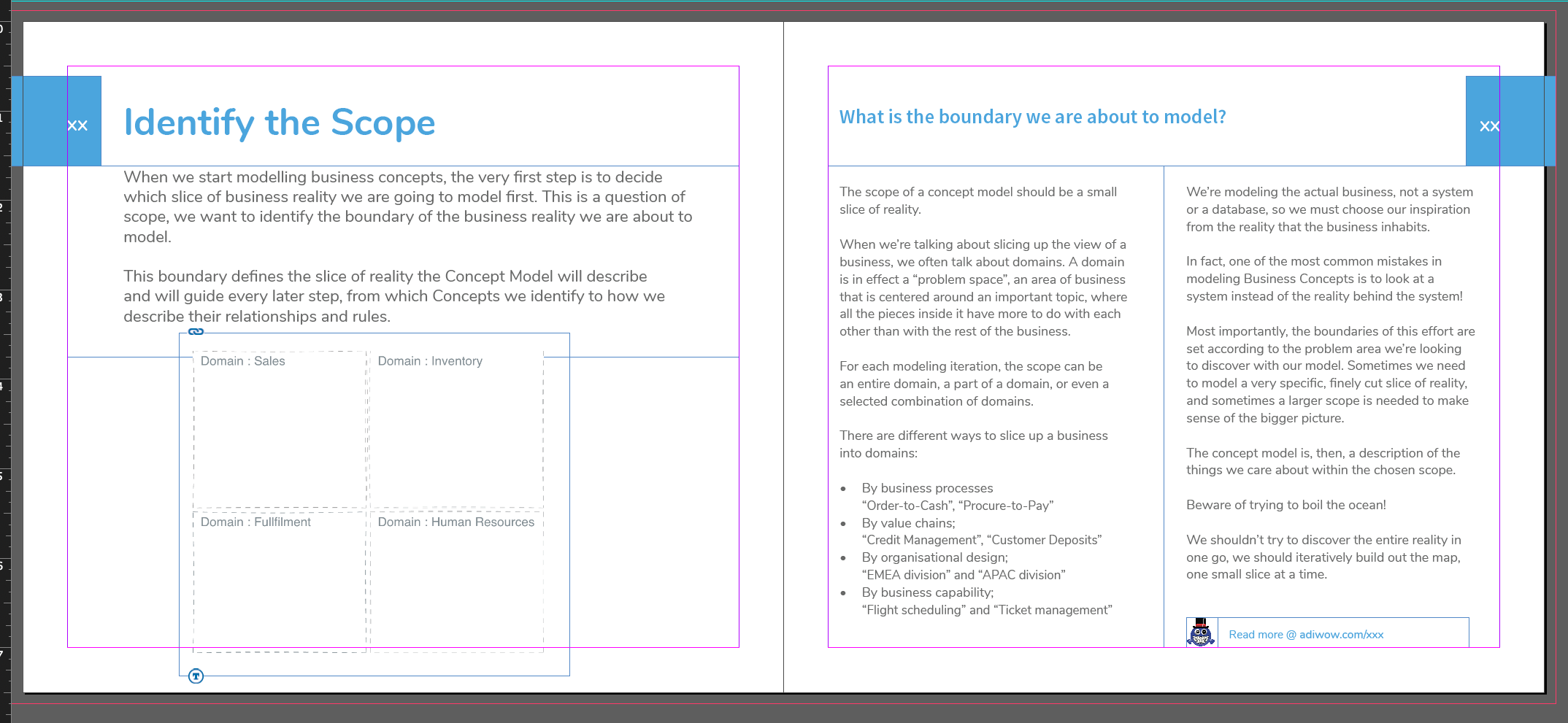
I loved the prose that Juha Korpela crafted for the opening of this page.
”Imagine you’re a landscape painter. You’re sitting outside on a hillside. On the left opens a view of rolling hills and fields. On the right there’s a dark forest of tall trees and brambles. What your painting ends up looking like depends very much on which direction you decide to look at!”
Unfortunately when I tried to extend the analogy to the pages for the other steps, it didn’t really work. Even with multiple goes using multiple LLM’s.
So back to the same format of opening for the Green book.
Still need to work on the #D Images for these pages, but started putting place holder images in there for now to see if they work as a concept.
18th December 2025
As I mentioned in the:

One of the first things Juha Korpela and I needed to define and agree was the steps in that process.
Now we have done that we need to draft very rough content for each step to see what steps survive and which get iterated, reordered or removed completely.
So here is the first very rough version of the first step.
Structure of these pages
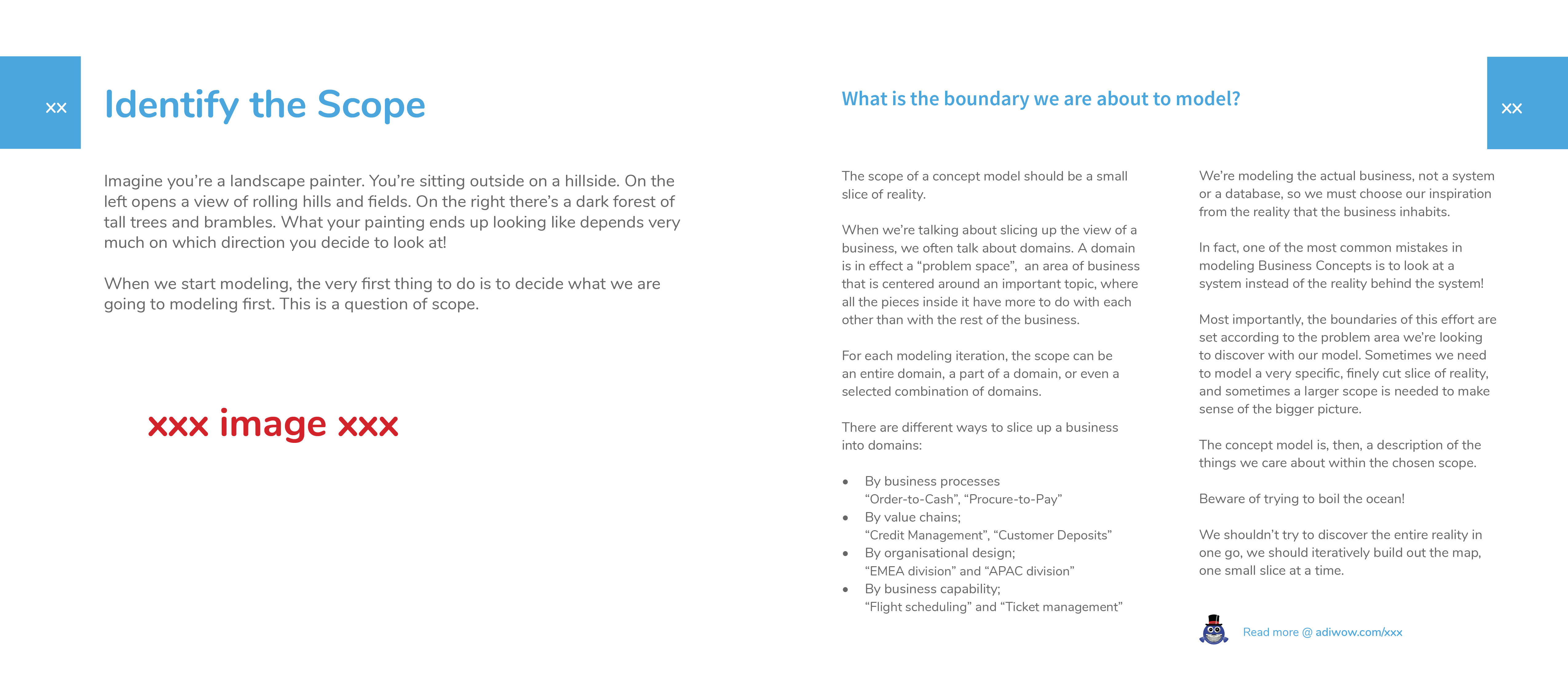
In the Agile Data Guides we use a pattern of describing a part of a Pattern Storming process or an area of a Pattern Template in across a consistent two page layout/spread :
At the top left we give it a name, and top right we provide a question this step / area will answer to quickly give the reader of the page the context at a glance;
Middle left we provide a short framing statement that explains the intent of the step or area and anchors why it matters before going into detail;
Bottom left a zoomed in image that provides a visual clue of this step or area in the context of the complete process or template;
First column on the right provides practical guidance on how to complete this step or area, including relevant examples;
Second column on the right provides more context, examples or anti-patters to watch out for when completing this step or area.
We repeat this layout / content as a dedicated page for each step or each area.
As you can see there is a visual combination of text and whitespace, so we make multiple iterations of this content as we write the guide, until we have just the right level of text content that provides everything you need to know and nothing you don’t.
How should we add out thoughts?
As we have mentioned in previous articles we are writing in public for this Agile Data Guide, which means we will post our thoughts in the content as we iterate it.
Last article I used the comments part of Substack to do that, this time I am experimenting with my thoughts inline as part of the article, feel free to post a comment on which pattern you prefer we use, our thoughts inline or our thoughts added as comments?
Thoughts on the Scope content
I love the way Juha created the intro text by using something outside the data domain to explain the concept of what scope is and why we should care.
I am not sure we can carry this same example through all the step pages, but i’m very keen to retain this way of crafting the framing statement.
We are working on the full example Concept Model visual diagram we are going to use for the book at the moment so currently just a placeholder for that visual image in this page.
I like the way the content refers to “reality” this is a key theme of the guide, so its good to reinforce it where it makes sense.
Its tempting to add text that define what a Domain is, but I feel that its better to just provide examples of domains and let the reader create their own defintion. But I am up in the air on this one, something for Juha and I to discuss further.
We need to iterate the list of domains we currently provide as examples, so far we have:
By business processes
By value chains;
By organisational design;
By business capability;
And we probably need to create a longer set of content for these in both the Purple Pattern chapter of the Guide and the companion Substack site for those that want to read more.
Also not sure providing the examples Domains directly under the Domain boundary / type bullet point is the best visual option, not sure if it gets lost and should be on its own, or if co-locating it provides the best context.
By business processes
“Order-to-Cash”, “Procure-to-Pay”By value chains;
“Credit Management”, “Customer Deposits”By organisational design;
“EMEA division” and “APAC division”By business capability;
“Flight scheduling” and “Ticket management”
The organisational design example is interesting, I always think of this one as Finance vs Sales vs Human Resources, but that often overlaps a lot with Business Capability. The regional / location division is an interesting example, but maybe only relevant to large organisations?
The second column needs iteration, there is a bit of redundancy in the text, but it is highlighting the two key points we wanted:
Don’t define your Concept Model based on your source systems.
Make each iteration of the Concept Model as small as possible.
Last thing is I think we have covered what a scope / domain is, and what not to do when identifying one, but not sure we actually cover the How to define one.
As always all comments and feedback on what works, what doesn’t, what you like, what you don’t like, whats missing etc is appreciated, so feel free to add comments.
The issue of domain boundaries is super interesting, but also a potential rabbithole of epic proportions I think! Furthermore, I'm not sure we should take the reader too close to DDD stuff - after all, the scope of a conceptual model can also be something else than a clearly bounded domain. (Though, even in that case, understanding which domains you are touching and how they are delineated is going to be important.)