

One of the interesting things in working with Juha Korpela as a co-author vs writing by myself is the inherent knowledge I already have about the structure of the Agile Data Guides and the fact that Juha does not.
When I wrote the Green Book, “an Agile Data Guide to Information Product Canvas” I spent an inordinate amount of time and effort on the structure of the book, as well as the layout and the colours.
To be clear the structure of the Green Book was an iteration on the Business Model Canvas book, a book I have loved and admired for many years.
This focus on the structure of the Green Book gave me a Pattern Template for the future Agile Data Guides I had backlogged to write. I was working in advanced to hopefully benefit from that effort in the future.
When I started drafting the Pink Book, “an Agile Data Guide to Data Persona Template” I got to test that Pattern Template, test whether this structure, layout and colours would survive a second iteration, and they did.
But it is a Pattern Template that only I understand and one I hadn’t documented.
Juha sent me a message on our shared slack channel, the message went:
“Shane Gibson for my thinking reference, could you give a brief overview of the various color chapters here? What’s each chapter for etc. You probably have this deeply ingrained in your brain at this point, but I’ve only read your information canvas book once so I keep forgetting which is which 😄”
(we are using Google Docs, Slack and Trello as our primary authoring and collaboration tools, yet another experiment to see how they go for two people to co-author a book remotely and asynchronously.)
I sent Juha back a short set of bullet points in the structure of the guides.
But I thought I might as well document or describe the Pattern Template structure of an Agile Data Guide in more detail here, because you might find it interesting.
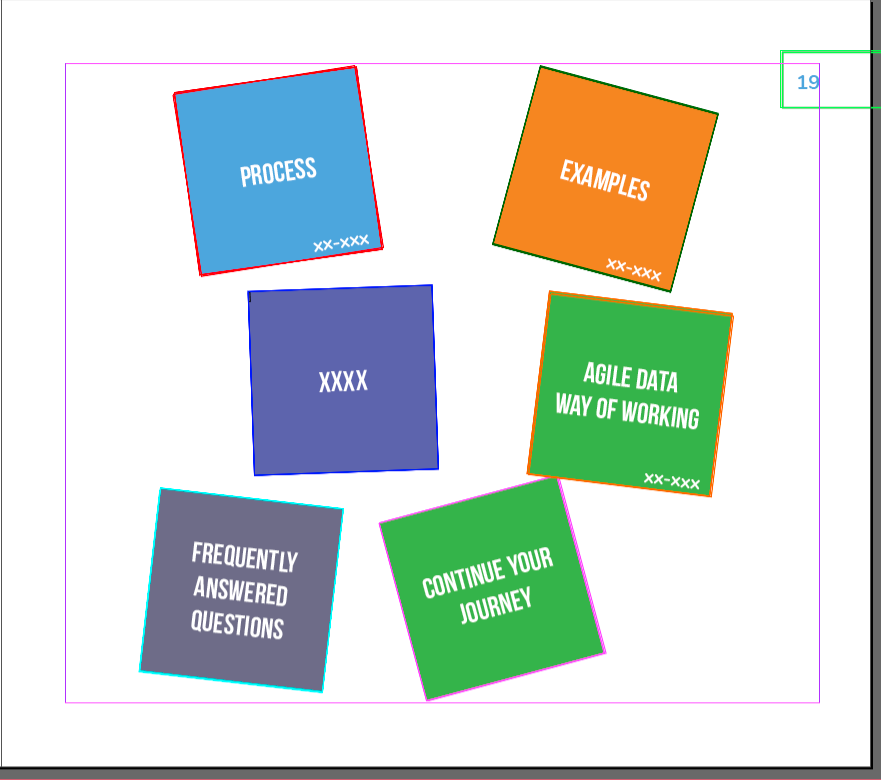
Chapter 1 - White Chapter - Introduction
This chapter is an introduction to the guide, it tells the reader why they should care and why they should keep reading.
It sets the scene for the book.
It covers the problems the book is trying to help solve, the benefits the reader will get from reading it and who wrote it.
It also covers the definition of the Pattern or Pattern Templates described in the book, anchoring the reader to the semantic language or context used in the book.
Chapter 2 - Blue Chapter - Process
The colour of this chapter is different for each guide, it matches the colour of the cover, the name on the spine of the guide, in this case its the Blue Book.
This chapter is the meat and potatoes of the guide, this chapter explains the key Pattern or Pattern Template we are teaching or sharing in the guide.
The goal is for the person reading this chapter to be able to walk away and try to apply the thing we are describing in this chapter immediately after reading it.
For the Blue Book, this chapter currently has a placeholder name of “Process”, this will be iterated as we continue to write the book and discover a better name for the chapter.
Chapter 3 - Orange Chapter - Examples
This is where we provide example Business Concept Models (or Maps as we think of them), with some narrative about that example.
I found that providing example Canvases in the Green Book, was a great way of reiterating the patterns inherent in the canvas template and help people to understand what it is and how to use it.
We think Business Concept Map examples will achieve the same outcome.
The chapter is based on a pattern of learning by example so to speak.
Chapter 4 - Purple Chapter - Supporting Patterns
This chapter has all the additional content and information that is useful to support a readers understanding of the core Pattern or Pattern Template the book is focussed on.
While the book is always focused on one core Pattern or Pattern Template, there are always a ton of other patterns and templates that support its use, we describe those here.
For example in the Blue Book we are planning to cover how a Concept Map compares to an ERD, how Concept Maps can be represented as a Matrix, how a Concept Map with an enterprise focus might be different to one with an incremental delivery focus.
At the moment this chapter has a placeholder name of XXXX. We will wait until we have drafted a number of the Purple chapter articles and then the core theme for that chapter will emerge and that is what we will name it.
Chapter 5 - Green Chapter - Agile Data Way of Working
This chapter is repeated across all Agile Data Guides, it provides a blueprint of the patterns that I use to help a data and analytics team change the way they work.
This content will be iterated in each guide, as I learn more writing the next guide and will retrospectively be updated in the previous published guides.
I am intrigued on how working with Juha on this book will result in iterations to this chapter and the overachieving set of patterns that make up the current blueprint.
Chapter 6 - Grey Chapter - Frequently Answered Questions
Text based Q&A style content that answers the questions that get commonly asked.
This chapter reiterates the key messaging and content already in the book, just in a slightly different format.
It essentially uses a re-articulation pattern, deliberately repeating and reframing earlier content so the reader hears the same ideas from different angles.
I tend to collect these questions when running the course that the book has been tested and validated based on, so will be interesting to see how Juha and I gather these questions for this book.
Chapter 7 - Green Chapter - Continue Your Journey
This is the last chapter and provides more information on where people can get more great content to continue their learning on Modeling Business Concepts or other adjacent content that would be valuable.
We provide links to books and courses from other authors that would be valuable to the reader and we provide links to the extended content we have written to support this book.
We also get a guest expert to write a couple of pages on how they apply a related Pattern or Pattern Template in this area.
A way to write Agile Data Guides with agility
And that my friends is the repeatable structure of “an Agile Data Guide”.
As with all things in the Agile Data Way of Working there is both a structure that can be repeated, but also a structure that can be adapted given a particular context.
One of the interesting things with the Blue Book is that the core chapter in the Green and Pink books (Chapter 2) are both based on describing a Pattern Template. The supporting parts of those books describe the Pattern or process you can take to use and apply that template.
For the Blue Book, we are flipping that.
The core chapter, the Blue chapter, is describing the process you can use to Model Business Concepts, and the supporting parts of the book describe the Pattern Template of a map or a diagram that you can use to capture the content you elicit out of that process.
It will be very very interesting to see how much of the structure of the guide we need to iterate as a result of this change in context.
This is a really great, structured way to write a practical guide for doing things. After I got the overall idea, it had already made it so much easier for me to start writing stuff to "fill in the blanks" for my part!
I resonate with what you wrote here, it realy highlights how much implicit knowledge we carry. Having such an intuitive pattern template for your books sounds incredibly efficient, like a personal internal API. Do you find that documenting these 'deeply ingrained' systems refines your own understanding further? Your foresight is so inspiring.