

7th September 2026
First iteration.
Identify the Concepts
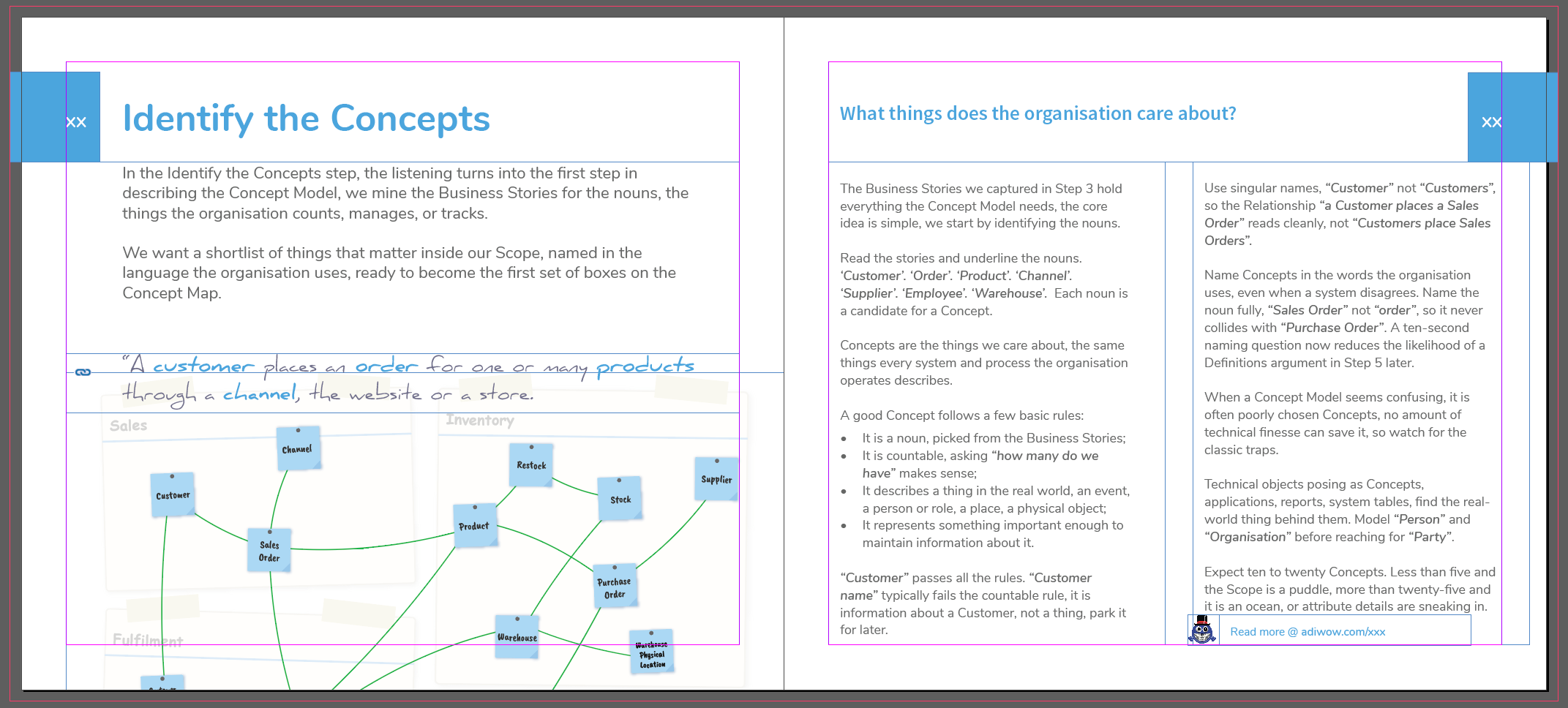
In the Identify the Concepts step, the listening turns into the first step in describing the Concept Model, we mine the Business Stories for the nouns, the things the organisation counts, manages, or tracks.
We want a shortlist of things that matter inside our Scope, named in the language the organisation uses, ready to become the first set of boxes on the Concept Map.
What things does the organisation care about?
The Business Stories we captured in Step 3 hold everything the Concept Model needs, the core idea is simple, we start by identifying the nouns.
Read the stories and underline the nouns. ‘Customer’. ‘Order’. ‘Product’. ‘Channel’. ‘Supplier’. ‘Employee’. ‘Warehouse’. Each noun is a candidate for a Concept.
Concepts are the things we care about, the same things every system and process the organisation operates describes.
A good Concept follows a few basic rules:
It is a noun, picked from the Business Stories;
It is countable, asking “how many do we have” makes sense;
It describes a thing in the real world, an event, a person or role, a place, a physical object;
It represents something important enough to maintain information about it.
“Customer” passes all the rules. “Customer name” typically fails the countable rule, it is information about a Customer, not a thing, park it for later.
Use singular names, “Customer” not “Customers”, so the Relationship “a Customer places a Sales Order” reads cleanly, not “Customers place Sales Orders”.
Name Concepts in the words the organisation uses, even when a system disagrees. Name the noun fully, “Sales Order” not “order”, so it never collides with “Purchase Order”. A ten-second naming question now reduces the likelihood of a Definitions argument in Step 5 later.
When a Concept Model seems confusing, it is often poorly chosen Concepts, no amount of technical finesse can save it, so watch for the classic traps.
Technical objects posing as Concepts, applications, reports, system tables, find the real-world thing behind them. Model “Person” and “Organisation” before reaching for “Party”.
Expect ten to twenty Concepts. Less than five and the Scope is a puddle, more than twenty-five and it is an ocean, or attribute details are sneaking in.