

19th October 2026
Moved to the 4 page spread pattern.
Split out the way Juha elicits the stories compared to how Shane does it.
Capture Business Stories
With the Scope agreed and the Subject Matter Expert in the room, we ask them to tell us what happens in the organisation, as a story, as a narrative, using natural language.
We want real-life narratives of how work happens, in the organisation’s own words. The same stories we hear when we follow a customer or an employee through their journey, or walk a process from end to end.
What makes a good Business Story?
Most of what makes an organisation unique is written down nowhere. It lives in people’s heads. The quickest way to reach it is to ask them for a story.
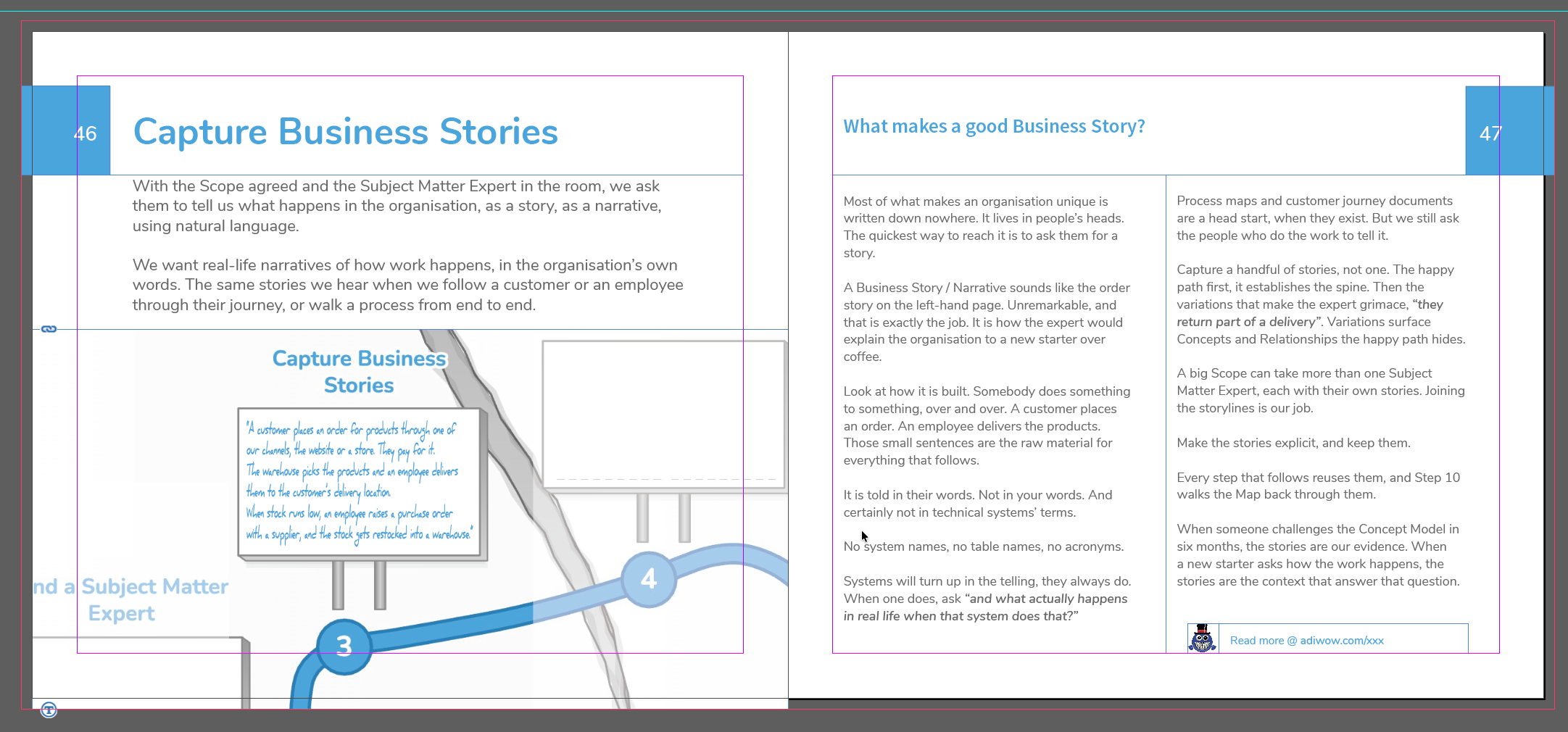
A Business Story / Narrative sounds like the order story on the left-hand page. Unremarkable, and that is exactly the job. It is how the expert would explain the organisation to a new starter over coffee.
Look at how it is built. Somebody does something to something, over and over. A customer places an order. An employee delivers the products. Those small sentences are the raw material for everything that follows.
It is told in their words. Not in your words. And certainly not in technical systems’ terms.
No system names, no table names, no acronyms.
Systems will turn up in the telling, they always do. When one does, ask “and what actually happens in real life when that system does that?”
Process maps and customer journey documents are a head start, when they exist. But we still ask the people who do the work to tell it.
Capture a handful of stories, not one. The happy path first, it establishes the spine. Then the variations that make the expert grimace, “they return part of a delivery”. Variations surface Concepts and Relationships the happy path hides.
A big Scope can take more than one Subject Matter Expert, each with their own stories. Joining the storylines is our job.
Make the stories explicit, and keep them.
Every step that follows reuses them, and Step 10 walks the Map back through them.
When someone challenges the Concept Model in six months, the stories are our evidence. When a new starter asks how the work happens, the stories are the context that answer that question.
Tell me a story
Ask the Subject Matter Expert one question, “walk us through what happens, from the beginning”. Then be quiet.
Our job is to listen, and to write down or record what they say as they say it. A clarifying question now and then is fine. So is a gentle steer back when the story wanders off into a system, or past the Scope sentence. Park what is out of Scope on the list and carry on.
Some Subject Matter Experts can talk all day from one question, perfect! Others need a little help to get started. A few patterns that often work to kick-start the process:
Choose a protagonist. Somebody outside the organisation, a new customer, a supplier. Somebody inside it, an employee. Or even a thing, a credit card, a product, an invoice. Ask them to walk us through the protagonist’s journey inside the Scope defined in Step 1. “How does someone become a customer?”, “What do they actually do when they buy?”, “ Who or what do they interact with?”, “How do they stop being a customer?”
Follow a process. A protagonist is one person or thing. A process has several people in it, each doing a different but connected part of the work. Skip the diagrams and ask the expert to narrate it in their own words. “How does it start, what triggers it?”, “Who is involved, and in which order?”
Walk backwards from the result. Start from the thing we most need to understand, often a number the organisation watches. Take churn. “What affects it?”, “What does a churning customer actually do, or stop doing, in real life?”
What we should have at the end of the session is the Business Story in the expert’s own voice. And if none of the three gets the story going, there is a more directed pattern.
Who does what?
Sometimes none of the three patterns gets the Subject Matter Expert flowing. Or the story stalls after a couple of sentences. We can stop asking for a story and elicit it with a repeated question. “Who does what?”
The answer comes back in one shape. Somebody does something to something. ‘A customer places an order’.
Write it down as one sentence, where the expert can see it. In the present tense, in their words. They will correct it while it is still warm. Then ask “what happens next?”
‘The customer pays for the order’, ‘The warehouse picks the products for the order’, ‘An employee delivers the order to the customer’. Each answer is another sentence, and the story builds a line at a time.
Some answers have nobody in them. ‘The stock gets restocked’. A story that follows a thing is full of them, an invoice gets created, approved, sent and paid. Ask “who makes that step happen?” and write down the sentence that comes back.
A sentence can carry more than two things. ‘A customer places an order for products through a channel’. Keep them all, they are all part of what happened.
Once the happy path is down, ask “is it ever handled differently?” Each special case is a few more sentences.
Then read the ‘Who does what’ list back to the expert, top to bottom, and it should sound like how the work really happens.
Either way we leave the room with the same thing, the Business Story in the expert’s own words.
7th September 2026
First iteration.
Capture Business Stories
In the Capture Business Stories step, we ask the Subject Matter Expert to tell us what happens in the organisation, as a story, as a narrative, using natural language.
We want real-life narratives of how work happens, in the organisation’s own words. The same stories we hear when we follow a customer’s journey or walk a process from end to end.
“A customer places an order for one or many products through a channel, the website or a store. They pay for it. The warehouse picks the products and an employee delivers them to the customer’s delivery location. When stock runs low, an employee raises a purchase order with a supplier, and the stock gets restocked into a warehouse.”
How do we get our expert to tell us the relevant story?
Ask the Subject Matter Expert one question: “walk me through what happens, from the beginning”. Then be quiet and write down or record what they say, in their words. Not in your words. And certainly not in the data platform’s our technical systems words.
A Business Story / Narrative sounds like the customer order story on the left hand page. Unremarkable, and that is exactly the job. It is how the expert would explain the organisation to a new starter over coffee.
No system names, no table names, no acronyms. If one creeps in, gently ask “and what actually happens in real life when that system does that?”
Some Subject Matter Experts can talk all day from one question, perfect!. Others need another way to begin.
Choose a protagonist. A person, a new customer, or even a thing, a credit card, a product. Follow them through their journey inside the Scope you have already chosen. “How does someone become a customer? Who do they meet?”
Follow a process. Skip the diagrams and ask the expert to narrate it in their own words. “Who does what? What is being processed?”
Walk backwards from the result. Start from the thing we most need to understand. Take churn. “What does a churning customer actually do, or stop doing, in real life?”
Capture a handful of stories, not one. The happy path first, it establishes the spine. Then the variations that make the expert grimace, “they return part of a delivery”. Variations surface Concepts and rules the happy path hides.
We both did this step unconsciously for years. Never conciously doing it caused us no end of problems when we came to draw the Concept Map together for this guide.
So make the stories explicit, and keep them. Every step that follows reuses them, and Step 11 walks the Concept Map back through them. When someone challenges the Concept Model in a years time, the stories are our evidence.