

10th October 2026
Still need to sort out a hero image for it we don’t hate.
Find a Subject Matter Expert
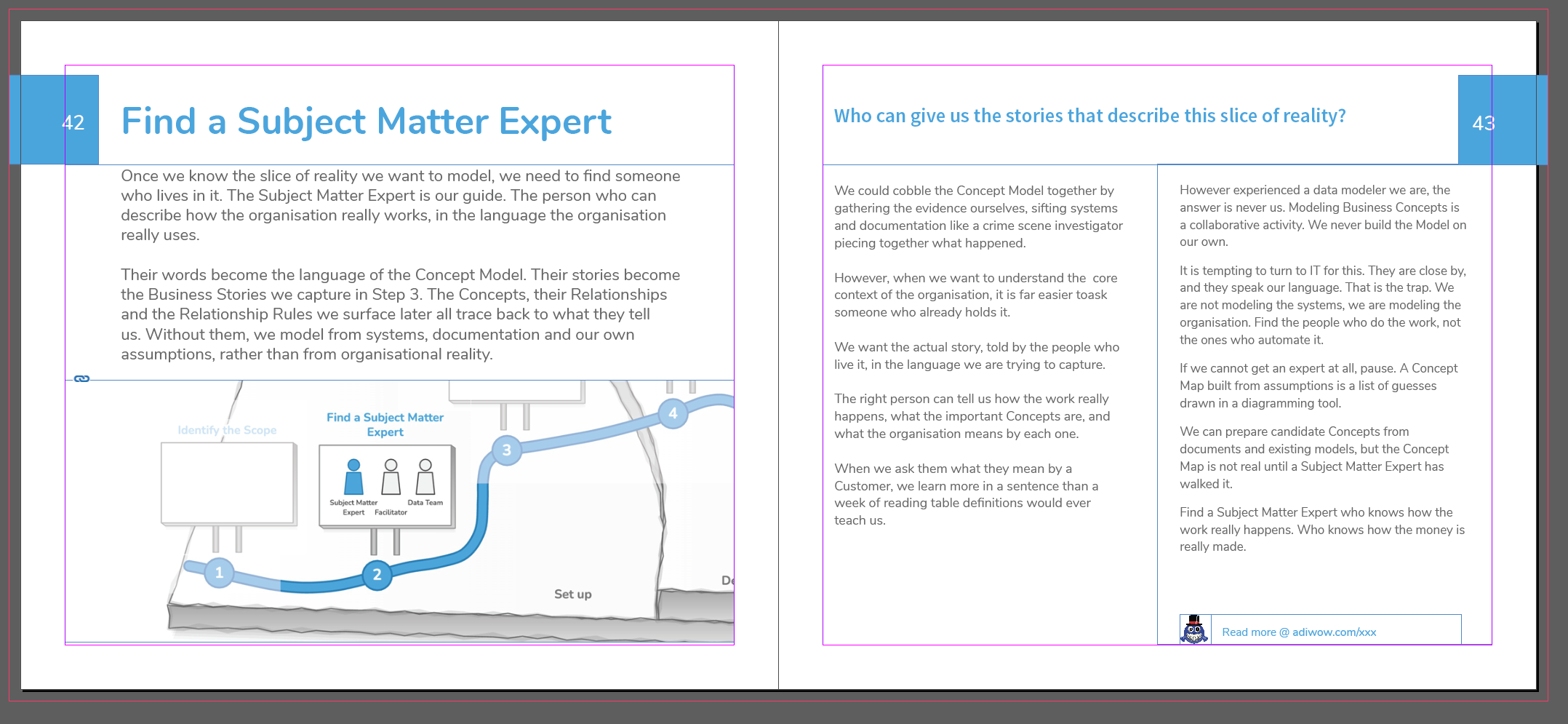
Once we know the slice of reality we want to model, we need to find someone who lives in it. The Subject Matter Expert is our guide. The person who can describe how the organisation really works, in the language the organisation really uses.
Their words become the language of the Concept Model. Their stories become the Business Stories we capture in Step 3. The Concepts, their Relationships and the Relationship Rules we surface later all trace back to what they tell us. Without them, we model from systems, documentation and our own assumptions, rather than from organisational reality.
Who can give us the stories that describe this slice of reality?
We could cobble the Concept Model together by gathering the evidence ourselves, sifting systems and documentation like a crime scene investigator piecing together what happened.
However, when we want to understand the core context of the organisation, it is far easier toask someone who already holds it.
We want the actual story, told by the people who live it, in the language we are trying to capture.
The right person can tell us how the work really happens, what the important Concepts are, and what the organisation means by each one.
When we ask them what they mean by a Customer, we learn more in a sentence than a week of reading table definitions would ever teach us.
However experienced a data modeler we are, the answer is never us. Modeling Business Concepts is a collaborative activity. We never build the Model on our own.
It is tempting to turn to IT for this. They are close by, and they speak our language. That is the trap. We are not modeling the systems, we are modeling the organisation. Find the people who do the work, not the ones who automate it.
If we cannot get an expert at all, pause. A Concept Map built from assumptions is a list of guesses drawn in a diagramming tool.
We can prepare candidate Concepts from documents and existing models, but the Concept Map is not real until a Subject Matter Expert has walked it.
Find a Subject Matter Expert who knows how the work really happens. Who knows how the money is really made.
Who to look for
The ideal Subject Matter Expert has hands-on experience in the slice of the organisation we are modeling. They understand the individual tasks and the wider processes those tasks sit inside. And they can zoom out, simplifying the detail when a higher level of abstraction is all we need.
In practice they do the work, manage the work or lead the work. The operations manager who untangles every exception. The person in the store who knows why some orders ship from the other warehouse.
And often it is the person everyone else goes to when the process gets uncertain. Uncertainty is where the modeling magic happens, the weird edge cases reveal the missing rules.
Ask “who can tell me what happens in this process?” or “who knows how things work in this team?” and listen to whose name comes up first.
The right person starts talking about the work. The wrong person starts talking about the systems. The right person does not have to understand what a data model is, and it is often better if they do not.
Sometimes one person cannot cover the Scope and we need two or three. That is fine. If it takes a crowd, the slice is probably too big. Go back to the Scope and narrow it.
Two experts who disagree are the discovery. Every disagreement is a Definition or a Relationship Rule the organisation never wrote down, surfacing in a session instead of in production.
Our Subject Matter Expert is the retail operations manager. She has run stores, managed the warehouse roster, and chased more late deliveries than she cares to remember. She has never seen the order system’s data model, which is exactly what makes her perfect.
How do we invite our expert
Occasionally we hear that the people we need are too busy, and that even if they had the time they would not understand what we were asking. The opposite is true. People love talking about their work. They rarely get asked about it properly. When someone listens with genuine curiosity, the stories flow.
So ask for something small. A first discovery session for a well-scoped slice takes sixty to ninety minutes. Nothing to read beforehand, nothing to prepare.
Ask for their permission to help you discover and capture stories, not for attendance in a technical session. “We would like you to walk us through how an order really happens” is an invitation.
Tell them what they will see during the session. Their words going up on a wall or a shared screen as they speak, where they can correct them on the spot.
Say who else will be in the room. A Facilitator who asks the questions, and the Data Team, who mostly listen.
Tell them what they get back. A Concept Map drawn from their stories, brought back for them to check. And the Definitions that go with it, in their words. The next time someone asks what a late delivery means, the answer is ready to share.
Then talk about their work. Make new friends. Learn how the money is made. The relationship built in this step pays for itself for years.
We never draw a Concept Map on our own, send it to them beforehand and tell them the session is to review it. “Please attend our data modeling session” or “Please review our data model” sounds like homework. “Walk us through how an order really happens” sounds like show and tell.
25th September 2026
First iteration.
Still need to sort out a hero image for it we dont hate.
Find a Subject Matter Expert
Once we know the slice of reality we want to model, we need to find someone who lives in it. The Subject Matter Expert is our guide. The person who can describe how the organisation really works, in the language the organisation really uses.
Their words become the language of the Concept Model. Their stories become the Business Stories we capture in the next step. The Concepts, their Relationships and the Relationship Rules we surface later all trace back to what they tell us. Without them, we model from systems, documentation and our own assumptions, rather than from organisational reality.
Who can give us the stories that describe this slice of reality?
We could cobble the Concept Model together by gathering the evidence ourselves, sifting systems and documentation like a crime scene investigator piecing together what happened.
When we want the core context of the organisation, it is far easier to ask someone who already holds it.
The ideal Subject Matter Expert has hands-on experience in the slice we are modeling. They understand the individual tasks and the wider processes those tasks sit inside. And they can zoom out, simplifying the detail when a higher level of abstraction is all we need.
Someone like this can tell us how the work really happens, what the important Concepts are, and what the organisation means by each one. Ask them what they mean by a Customer, and we learn more in a sentence than a week of reading table definitions would ever teach us.
The question to ask ourselves is “who can give us a narrative description, a series of stories, that explain this slice of the organisational reality?”
However experienced a modeler we are, the answer is never us. Modeling Business Concepts is a collaborative activity. We never build the Model on our own.
It is tempting to turn to IT for this. They are close by, and they speak our language. That is the trap. We are not modeling the systems, we are modeling the organisation. Find the people who do the work, not the ones who automate it.
Occasionally we hear that the people we need are too busy, and that even if they had the time they would not understand what we were asking. The opposite is true. People love talking about their work. They rarely get asked about it properly. When someone listens with genuine curiosity, the stories flow.
And if it takes a crowd of people to cover a single slice, the slice is probably too big. Go back to the scope and narrow it.
Find a Subject Matter Expert who knows how the work really happens. Who knows how the money is really made.