

7th September 2026
First iteration.
Introducing Modeling Business Concepts
For too long, data models have been created by data practitioners, for data practitioners. They describe tables, columns and keys, and they are validated by the only people who can read them, which is to say, other data practitioners.
The problems aren’t with how they create those diagrams. They are with who the diagrams are designed to serve and what the diagrams try to describe.
Most data model diagrams describe a technical system. Very few describe the organisational reality.
Yet every piece of data work rests on an understanding of how the organisation works.
Every Information Product, every pipeline, every data platform table encodes somebody’s mental model of customers, orders, products and the moments that connect them.
Every piece of data work has a Concept Model. The only question is whether that model was consciously written down and agreed, or whether it lives in someone’s head.
Modeling Business Concepts is how we get that model out of heads and onto a single, shared page. One the whole organisation can read and understand.
Agile Data Guides are not linear step-by-step manuals. They are a choose-your-own-adventure, empowering you to discover, explore and experiment with patterns that potentially solve your current challenges.
Whether designing a data platform, documenting your organisational context for AI, or upskilling your Data Team, the patterns and templates in this guide are flexible, reusable, and adaptable.
Combine these to craft your own Agile Data Way of Working, tailored to your organisation’s context. The patterns outlined in this guide are not a rigid methodology, they are a pattern library, the culmination of years of collaboration, experimentation, and refinement.
This book is a guide to change the way data teams and stakeholders understand their organisation. It introduces Modeling Business Concepts, helping teams create a shared language, capture it as a Concept Model, and turn it into pictures and words that reflect how your organisation actually works.
We hope this guide inspires you to change the way your data teams work, delivering more value, faster, with less waste. Whether your journey ends in massive change or incremental improvement depends on your context, your journey starts here.
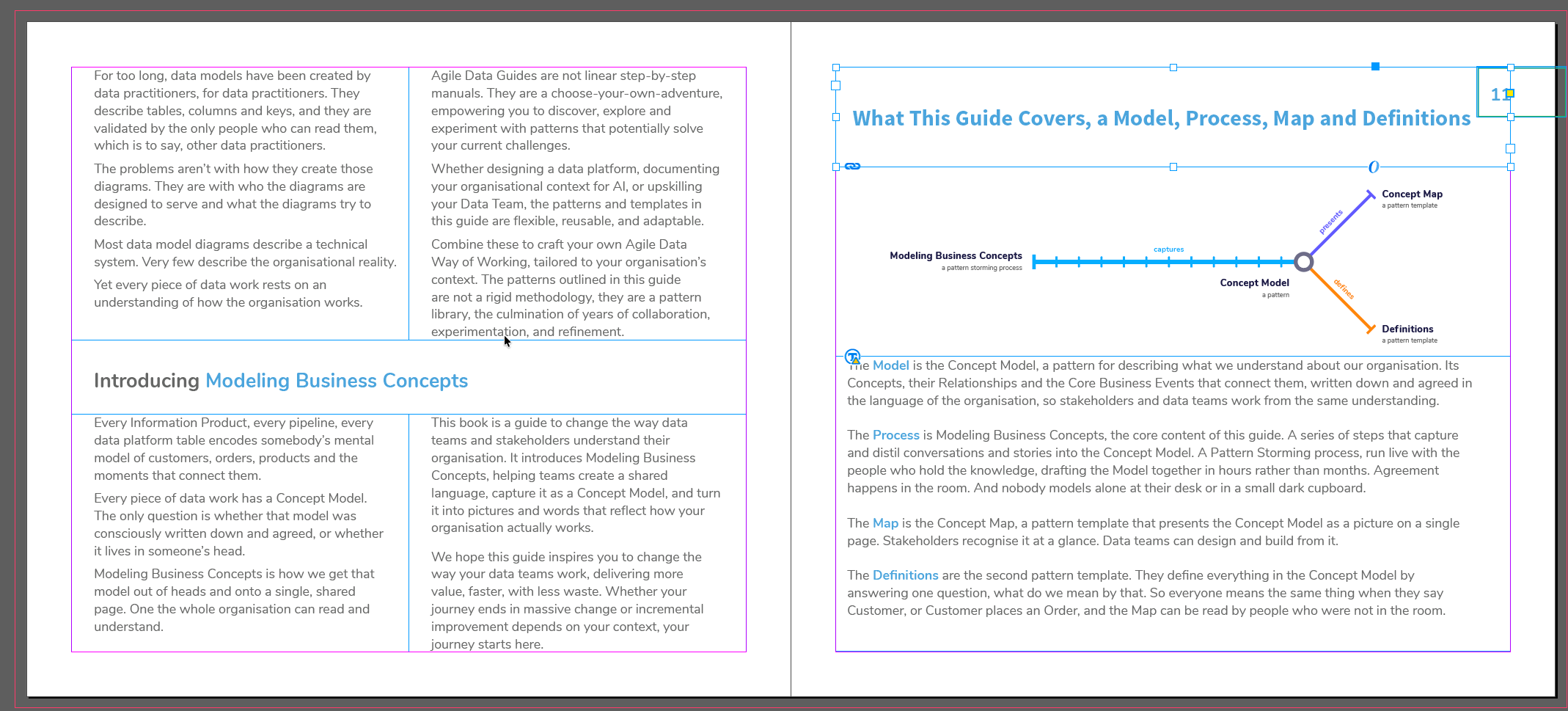
What This Guide Covers, a Model, Process, Map and Definitions
The Model is the Concept Model, a pattern for describing what we understand about our organisation. Its Concepts, their Relationships and the Core Business Events that connect them, written down and agreed in the language of the organisation, so stakeholders and data teams work from the same understanding.
The Process is Modeling Business Concepts, the core content of this guide. A series of steps that capture and distil conversations and stories into the Concept Model. A Pattern Storming process, run live with the people who hold the knowledge, drafting the Model together in hours rather than months. Agreement happens in the room. And nobody models alone at their desk or in a small dark cupboard.
The Map is the Concept Map, a pattern template that presents the Concept Model as a picture on a single page. Stakeholders recognise it at a glance. Data teams can design and build from it.
The Definitions are the second pattern template. They define everything in the Concept Model by answering one question, what do we mean by that. So everyone means the same thing when they say Customer, or Customer places an Order, and the Map can be read by people who were not in the room.